Chapter 2 Tropical Storm
Andrea 2013 Introduction I had crossed the Atlantic on a dream run from the Canaries southward and sailed through the Caribbean towards Cuba. Denny joined me for Christmas to cruise some of the islands. After she flew home, I continued sailing west.
Following a great time in Cuba, I left Hemingway Marina with another cruiser, Balvenie, to sail to Florida. It was quite a crossing with very strong winds, but the Gulf Stream pushed us north. The nights were dark and rainy at times. I had connection problems with the autopilot and had to hand steer for hours. In the end I hove-to and slept for 90 minutes. I finally made it to West Palm Beach, where I and four others cleared into the USA.
From there, I headed north via the Intracoastal Waterway to Norfolk and then out into the expansive waters of Chesapeake Bay, including Annapolis and Baltimore. I traversed the Chesapeake and Delaware Canal going east and sailed south towards the open Atlantic. This required navigating the many sandbanks in this gulf, then rounding Cape May before I could turn north towards New York City.
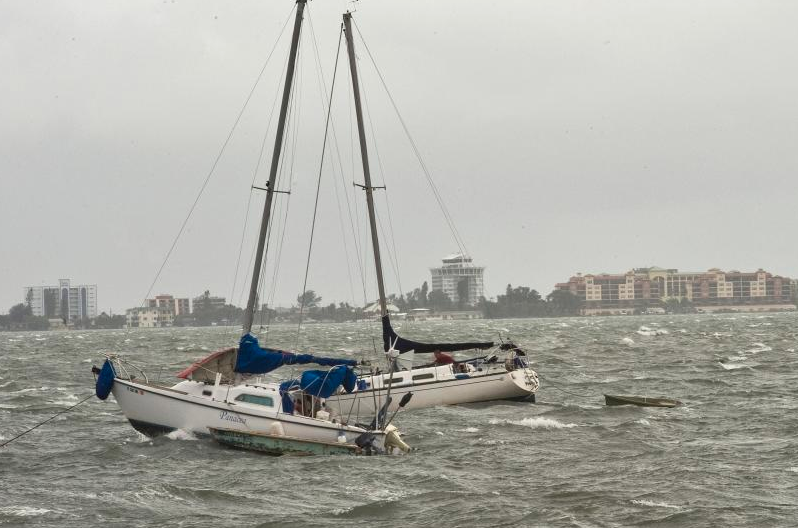
The Storm It was June, five days into the hurricane season, so I had to watch out for hurricanes forming in the Gulf and moving north. This wasn’t what I’d planned for, and I found myself caught right in the path of one coming north along the coast I was sailing. While not the worst storm the USA had experienced, such as Andrew, it still packed quite a punch.
Here is how I rode out that storm.
I needed rest after two days of steaming through the canal and south down the Delaware Bay with all its sand shoals. I navigated through the narrow entrance into what’s called a harbour, though it’s more like an enclosed river mouth with a bay stretching southeast to the town.
I dropped anchor inside the bay and fell asleep. Upon checking the weather forecast, I discovered I was right in the path of an Atlantic hurricane forming south and travelling north up the coast.
I pulled up the anchor to seek out a marina for shelter but only found one with no space but at least water and diesel. I filled all tanks to capacity and left to re-anchor, having learned that the shoreline, both sea and land, had quite shallow water.
This location was ideal for riding out any storm. The bay wasn’t wide or long, so big waves wouldn’t form, and the narrow, protected
entrance would prevent Atlantic storm swells from rolling in.
I dropped anchor with ample room aft and let out 75 m of my 10 mm chain. I checked that the rest would flow easily and ensured the join to the nylon rode was secure and free-flowing.
There was a hive of activity at the Coast Guard Training Centre abeam of where I’d anchored. Recruits stowed everything movable and doubled the lines on the few vessels in their dock. With all canvas well secured along with everything on my deck, I prepared a good meal and settled into bed, setting the alarm for midnight when the Tropical Storm was due to arrive.
Here’s an extract from Wikipedia regarding this storm:
“The first tropical cyclone and named
storm of the annual hurricane season,
Andrea originated from an area of low
pressure in the eastern Gulf of Mexico
on June 5. Despite strong wind shear
and an abundance of dry air, the storm
strengthened while initially heading
north-northeastward. Later on June 5,
it re-curved northeastward and
approached the Big Bend region of
Florida. Andrea intensified and peaked
as a strong tropical storm with winds at
65 mph (56 knots) on June 6. A few
hours later, the storm weakened
slightly and made landfall near
Steinhatchee, Florida later that day. It
began losing tropical characteristics
while tracking across Florida and
Georgia. Andrea transitioned into an
extra-tropical cyclone and moved along
the East Coast of the United States.”
Yes, I was right in its path as it moved north, but I was well prepared. I got a few hours’ sleep, but just before midnight, the wind started from the southeast. With ample room astern, I undid the snubber and let out all 100 m of chain from the locker. The nylon took the strain around the capstan.
The wind rose steadily. Thankfully, there was a short fetch, so the waves were quite small. Then came the rain and more wind. I let out another 20 m of nylon and started the engine, putting it in gear at idle to take strain off the anchor as I attempted to stay in one spot.
At the height of the wind, I had the engine in full ahead with the anchor straining to keep Malua in
position. From the cockpit, I watched the anchor alarm as we weaved back and forth with winds in the high 40 knots. The rain and noise were disconcerting, not that I had anyone to talk to. All vessels except one appeared to be holding their positions. A large yacht started to drag towards the seashore beach but thankfully stopped just short, its anchor presumably catching on something.
Around 4:00 am, the winds veered to the opposite direction (northeast), signalling time to up anchor and re-anchor with more room off my stern. This was challenging, as I had to gauge how the anchor chain was coming in from the cockpit while pressing the up-anchor button and steaming forward against the waves and wind. I’m sure I put strain on the windlass, but eventually, the anchor appeared over the bow. I steamed into the wind to drop it in a good position with sea room off my stern, letting out 75 m of chain again. The anchor set on the first attempt, and I was once more stationary with the Vesper Marine anchor watch set.
From about 5:00 am until dawn, with rain continuing all this time, I alternated between sitting in the cockpit with the engine running and watching the anchor alarm below deck. As light
broke, the rain and wind eased, allowing me to relax and have breakfast.
I wasn’t going anywhere for a few days until the open ocean calmed down, so I went ashore and walked around. It’s amazing how quickly one forgets the challenges of cruising.
The next stage was to enter the Hudson River and the Big Apple.
Was that a magical moment on Malua?
I then cruised north to New York, up to Rhode Island then south again to The Chesapeake where Malua was on the hard for the winter. I returned to sail south through the Panama canal and cross the Pacific to home in Australia. The pacific storm is in the next chapter.
← Back to Storms at Sea · Voyages · Next: Pacific Storm 2014 →