Chapter 3 Pacific Storm 2014 Introduction Crossing the Pacific on the way home after five years in the Mediterranean and two years in the Caribbean and USA, I was expecting an easy run.
I had a flat sea almost all the way from Cape Hatteras to Cuba and then an easy passage through the Panama Canal and on to the Galápagos. The time there was enjoyable, with some land travel. The 19-day sail from the Galápagos to the Marquesas Islands, with winds between 12 to 18 knots, was every single- handed sailor’s dream cruise. Warm, moderate winds always behind the beam.
French Polynesia is the world’s best cruising ground, with protected atolls, clear water, and wonderful drift dives through the channels. Eventually, I had to leave this paradise from Bora Bora and head on to Tonga to reach home.
Not only did I leave in a rush due to bureaucratic pressures, but I also left knowing I was heading into unsettled weather as I moved from the calm areas around the equator towards
the tropical latitudes and the Southern Ocean further south.
What happened on this leg wasn’t in the plan, and the impact and consequences have had lasting maintenance repercussions that I didn’t uncover at the time. Here’s the story of this storm.
The Storm Malua left French Polynesia after some difficulty with my crew member who did not want to leave Bora Bora. I left her in the hands of the local Gendarme and set sail out into a very unsettled weather system. I had no option but to leave, so off I went. After two days, the main engine started to give problems. It was either water in the fuel or the fuel was contaminated. The end result was I could run the engine to charge the batteries but not move the boat forward. Not a big deal in a sailing boat; however, there was no wind, so I just sat and waited.
Be careful what you wish for.
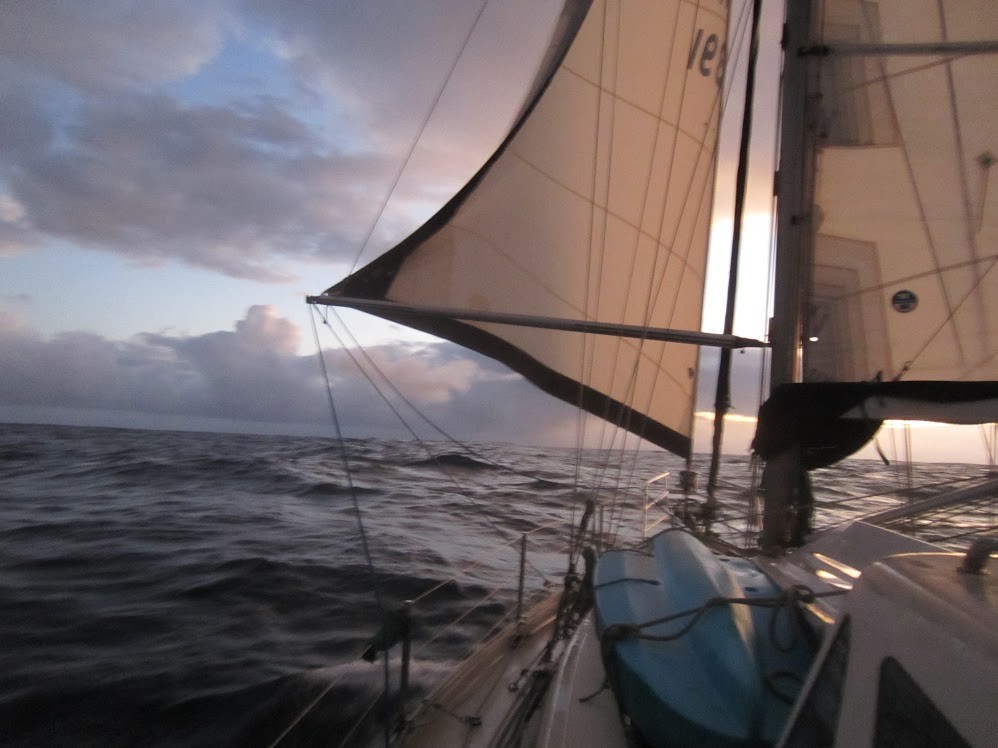
On the third day out, at dusk, the wind started to rise. By midnight, I watched as the wind rose from right astern, first 20 knots – OK, put in one reef; then 25 – OK, put in the second reef and furl the genoa; then 35 – well, it can’t go much higher. The boat was now doing 8 to 10 knots downwind.
This is where single-hander lethargy sets in. You do nothing either because you’re tired or you think it will get better. When the wind was at 40 knots, I decided to take the third reef in but did not move from my captain’s chair. It was then the wind rose to 45 and then 47 knots and BANG – the sail tore between the second and third reef points. Now there was no option but to take the torn sail down.
I stepped up into the cockpit and started to move forward when a large wave washed all over the port side of the boat. Time to clip onto the lifelines, turn all the outside lights on, and
secure the sail. Not a difficult job because Malua was still running before the wind and waves. The autopilot was handling the situation well.
When the sail was secure, I only had a small furled staysail out, and Malua was still doing 5 to 6 knots along the rhumb line to Tonga – 6 days away.
I slept well the rest of the night, but by morning, the seas from east of New Zealand had built to a massive 5 to 6 meters. Thankfully, they were quite ordered and pushing me in the right direction.
That afternoon, while I was in the captain’s chair at the nav station, the boat was slammed over to the starboard side by a huge wave. The dorade vent over the stove started to flood water, and I found myself on my side underneath a waterfall of seawater coming through the closed companionway hatch. Before I realised what had happened, Malua had righted herself, and I was drenched through.
There was water everywhere with about 2 inches over the floor.
I set about getting rid of the water by sweeping it into the bilge. Days later, I was to find the batteries swimming in a sea of water in their
purpose-built battery compartment. I would find water everywhere in the aft section of Malua. My quarter berth was wet, as were things on the chart table. The final water damage would be revealed days later.
I then realised that there was something flapping in the cockpit. I opened the companionway and looked out to find all the canvas from the bimini and weather cloths ripped to pieces. The two fenders secured at the stern had gone. The stern anchor tied to the lifeline was over the side, attached to the boat at the end of the anchor chain. The life recovery ring was trailing astern on its line. All the sheets
and lines kept in the cockpit and under the hard dodger were somewhere else. It was a mess.
Luckily it was light, so I set about retrieving the things trailing overboard and securing the other lines in their correct place.
I was to find out later that the engine fan vent located in the cockpit had been flooded along with the large cockpit locker containing one outboard engine. The other on the rail had had a good seawater submersion.
What could I do? Just run before the wind with only the small furled staysail to give me direction and drive. Five days later, I was off the northern tip of Tonga, hoping for a tow into the harbour by one of my friends. I contacted them on the HF radio, but they could not or would not give me a tow into the narrow entrance to the port of Neiafu on the northernmost island of Tonga. You soon find out who your friends really are.
I organised a commercial tow into the harbour, cleared in, and took a mooring buoy in Neiafu harbour. I had been here before in 2004. Relieved that I had made it to a place where I
could get the engine fixed and repair the sail.
The next chapter occurred a few years later.
No magical moment on Malua here.
← Back to Storms at Sea · Voyages · Next: Bass Strait 2017 →