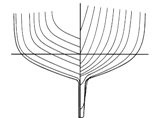
I have built a number of boats throughout my life. The first was a canoe with my father when I was a very young boy. Later we built our first sailing boat. From these beginnings I went on to hone my woodworking skills and created pieces of furniture for the house. The largest project was 10 dining room chairs based on a Cape Regency style. The pattern was taken from an antique chair in the Stellenbosch Museum. The chairs now stand as pride of place around our dinner table. In 1990 a purchased a 27 ft Bonbridge which I names Alibi. This got me sailing in Australia. I sailed up and down the east coast as far south as Eden. On returning to Batemans Bay after a trip south I was entering Bermagui Harbour in the middle of the might at the height of a storm and hit a rock… Well that is another story but while creating a new rudder for Alibi I decided that I was enjoying this task so much I would build a bigger boat! The major decision was whether to buy in the hull and deck or build it myself. I had the skills but did not have the time. There are not many ship building yards in Australia that do custom construction to a particular stage so the choice was simple.
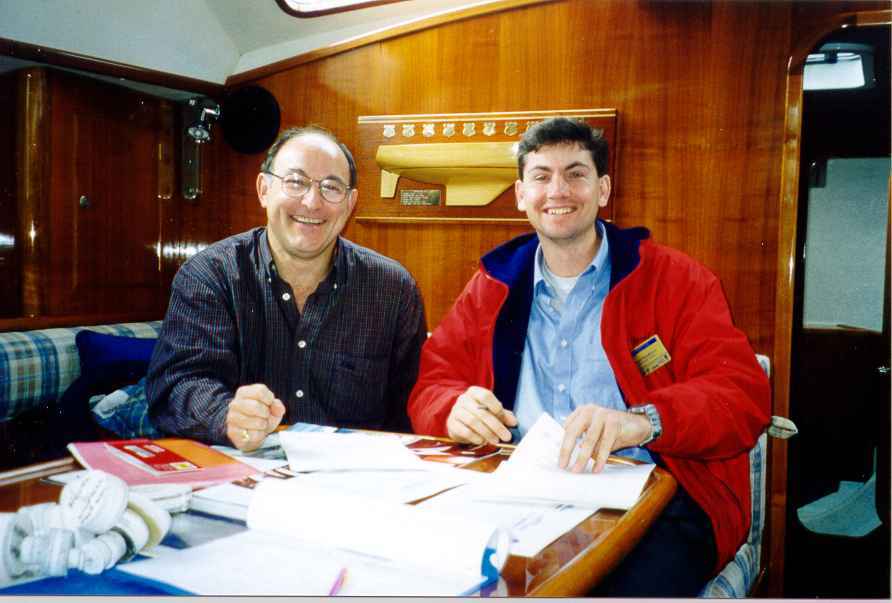
I commissioned a builder in Newcastle to construct the hull and deck and decided to do the fit-out in my yard in Canberra. We had some trouble lifting the hull over the power lines from the adjoining reserve. Unfortunately a linesman was tragically electrocuted during this operation which put quite a dampener on the start of this project. It took me weeks to come to terms with this event which occurred while I was watching him reconnect the high voltage power lines. The boat took three years to complete. I set about the interior design based on the principle that the major time spent on the boat would be at anchor. Thus the galley and the eating area are open and close together. The saloon is part of the navigation area yet separated so that the skipper can sit at the chart table while others are around the table. The main head doubles as the wet area and is close to the companionway while the second head is off the main cabin. A double cabin in the stern and a separate quarter berth completes the layout. Built into this basic design are the major systems and equipment as described on the next pages.
From hull to home
The hull and deck were made at Bluewater Yachts. I undertook some layup work with David and did extensive design work to ensure that it was constructed to the specifications. Unfortunately what was written in the contract and specifications was not delivered. This did not detract from the design nor the strength of the hull and deck, but as to meeting the contracted specifications and fulfilling obligations, the builder was way off the mark. The major problem was the engine shaft through hull design. An outback farmer could have built a more elegant job. It cost David and the project time and money. After some legal intervention I was able to take the vessel from his factory in Cardiff to complete in Canberra.
The project took about three years. I planned the layout around the time we would spend living aboard, built and installed the major components first, and then came back to the details. Work began at the bow and progressed aft. The raised saloon and timber interior were central to the result.
Here are some construction photos at the factory here…
The Myrtle interior
I wanted Tasmanian Myrtle but could not obtain enough timber, so the roughly two cubic metres of Myrtle came from South America. Veneered waterproof plywood was made for the joinery. The first veneer batch turned out darker than I wanted, so I commissioned another set. The work involved as much judgement about how the boat would feel as it did carpentry.
Here is a link to some of the construction photos to give you a feel here… Each section is covered as a page below.
The original construction archive includes records of the hull, bathroom and head, saloon, freezer, dodger and later rejuvenation. Those component stories and photographs can be restored alongside this overview.