It was June 2013, only five days into the hurricane season, and I was heading north towards New York after cruising Florida and Chesapeake Bay. After two days through the Chesapeake and Delaware Canal and down Delaware Bay, I needed a rest and entered Cape May. I did not expect that this quiet anchorage would become the place where I would ride out Tropical Storm Andrea.

Cape May and an approaching storm
I dropped anchor inside the bay and slept. When I checked the weather forecast I discovered that I was directly in the path of the storm moving north along the Atlantic coast.
I lifted the anchor and looked for a marina, but there was no berth available. I was able to take on water and diesel, filling the tanks before returning to the anchorage. Cape May offered one important advantage: the bay was neither wide nor long, so a large sea could not build, and the narrow protected entrance would keep the Atlantic storm swell outside.
Preparing Malua
I anchored with plenty of room astern and laid out 75 metres of my 10 mm chain. I checked that the rest of the chain would run freely and that the join to the nylon rode was secure.
Abeam of Malua, the Coast Guard Training Centre was a hive of activity. Recruits were stowing everything movable and doubling the lines on the vessels in their dock. I secured all the canvas and everything on deck, prepared a good meal and went to bed with the alarm set for midnight, when Andrea was due to arrive.
Andrea arrives
Just before midnight the wind began from the south-east. I undid the snubber and let out all 100 metres of chain from the locker, with the nylon rode taking the strain around the capstan.
The wind rose steadily. Fortunately the short fetch kept the waves relatively small, but then came the rain and still more wind. I let out another 20 metres of nylon and started the engine, initially leaving it in gear at idle to reduce the strain on the anchor.
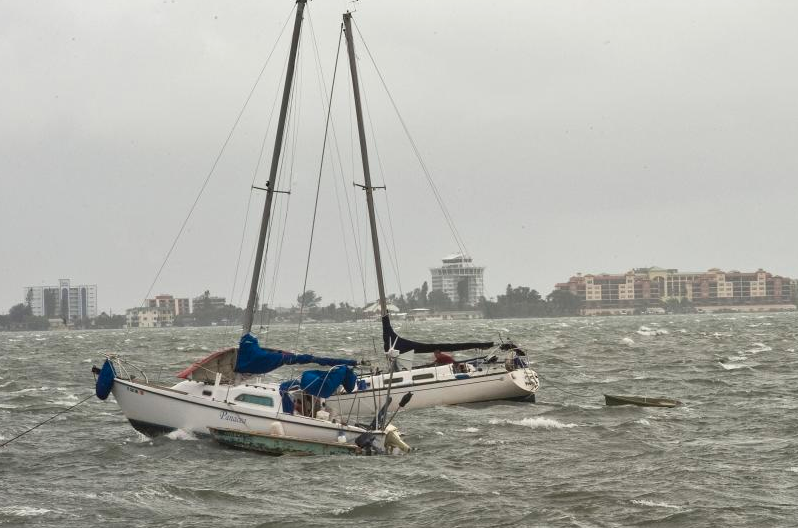
At the height of the storm I had the engine in full ahead while the anchor strained to hold Malua in position. From the cockpit I watched the Vesper Marine anchor alarm as the boat weaved back and forth in winds in the high 40-knot range. All the nearby vessels appeared to be holding except one large yacht, which began dragging towards the beach before its anchor caught again just short of the shore.
Re-anchoring in the dark
At about 4:00 am the wind veered to the north-east. That meant lifting the anchor and resetting it with more room off the stern.
Single-handed, this was a challenge. From the cockpit I had to judge how the chain was coming aboard while operating the windlass and steaming forward against the wind and waves. I am sure I put considerable strain on the windlass, but eventually the anchor appeared over the bow.
I motored into the wind, dropped it again in a better position and laid out 75 metres of chain. The anchor set on the first attempt and I reset the Vesper Marine anchor watch.
From about 5:00 am until dawn, with the rain continuing, I alternated between sitting in the cockpit with the engine running and watching the anchor alarm below. As daylight arrived the wind and rain eased. I could finally relax and have breakfast.
After Andrea
I was not going anywhere for a few days until the open ocean had calmed down. I went ashore and walked around Cape May. It is amazing how quickly one forgets the challenges of cruising.
The next stage was to head north for the Hudson River and the Big Apple. From New York I would continue through Long Island Sound to Rhode Island before eventually turning south again to Chesapeake Bay for the winter.