Chapter 5 Coffs Storm to
New Caledonia2018 Introduction While cruising, particularly around the world, one studies weather systems and becomes quite knowledgeable about their movement and intensity.
On Australia’s east coast, the systems are highs that develop over the centre of the continent and move east, or lows that spin off the Southern Ocean and move north up the coast before heading eastwards towards New Zealand. These lows can dissipate as they move or, in some cases, deepen and become East Coast Lows with intense weather systems around them. They’re dangerous because of the gradient of the isobars (i.e., the closer they are together, the stronger the wind), and the lower the pressure at the centre, the stronger the wind towards that centre.
Another factor is wind direction. On the west side of the low (for those in the Northern Hemisphere, our lows turn clockwise), the wind blows westward and then towards the north. We
all know (from the 2003 film, “Finding Nemo”) about the large and strong East Australian Current that originates in the Coral Sea as warm water, hits the coast at 15 degrees S, then flows south with its fastest speed up to 5 knots and strongest point off Cape Byron, NSW, before widening out near Tasmania.
When the southward-flowing current meets an East Coast Low moving north, with wind compressed between the centre low and the coast at speeds from 10 to 50 knots, the open sea can get ugly. The wind-driven swell and resultant waves collide with the warm water flowing south and the two forces of nature collide. The waves become steep, their tops tumbling down into the troughs. The backs of the waves are also steep, and many a Hobart- destined yacht has bashed through them to find their boat and gear weren’t up to this rollercoaster ride.
A yacht of Malua’s size must be very careful when running before these winds in steep seas. Go too fast, and you may speed down the face into the swell ahead and bury your boat in water. Loose your direction, and you may turn side-on to the swell and waves. Alternatively, if you travel slower than the swell, you may be
overcome by breaking waves and swamped by a big one.
My strategy is to run before the wind at an angle that keeps me moving diagonally to the waves at a speed that I and the autopilot can control.
When I set off from Coffs Harbour to cross the Tasman to New Caledonia – a 7-day passage – I had assumed the low would continue its track towards New Zealand, and I would get favourable winds all the way to my destination. The low stalled and didn’t move for days, and I sailed right into the edge of the East Coast Low. Here’s what happened.
The Storm
Should I go today or check in after clearing customs at Coffs Harbour? That was the question I now faced. I had been watching the low off the coast for a few days, and it looked as if the low was moving as expected towards NZ, so I decided to go. As I nosed out of the protection of the harbour, I realised that what looked like smooth water was not.
Now the wind was blowing from the south and the current was running southwards – in the opposite direction, so the ocean swell started to get steeper and steeper while the wave tops
were being blown off. I had put in one reef early, so when the wind reached 25 knots, the second reef went in, only for a very short time before I had to put the third reef in. I furled the genoa to almost nothing, but it was out on the spinnaker pole because I was now running diagonally down the face of the waves – the most prudent course in steep swells.
The wind instruments stopped working at 54 knots, but all was well on board.
Suddenly, the bilge alarm went off as I was at the wheel guiding Malua down the waves, not trusting the new autopilot. Once, then a second time the shriek of the alarm sounded, and then continuously with a scream that would wake the
dead. What was going on? Was there a hole in Malua, maybe a thru-hull had come adrift?
Down below, I lifted the bilge hatch to taste the water, but there was no need – the flow of water from the stern area was more than a breached tank would supply.
This was serious.
Maybe the shaft gland had come loose? I opened the door into the engine compartment. The shaft was OK, but the water flowing from the rudder area was a stream. Oh no! Not the rudder.
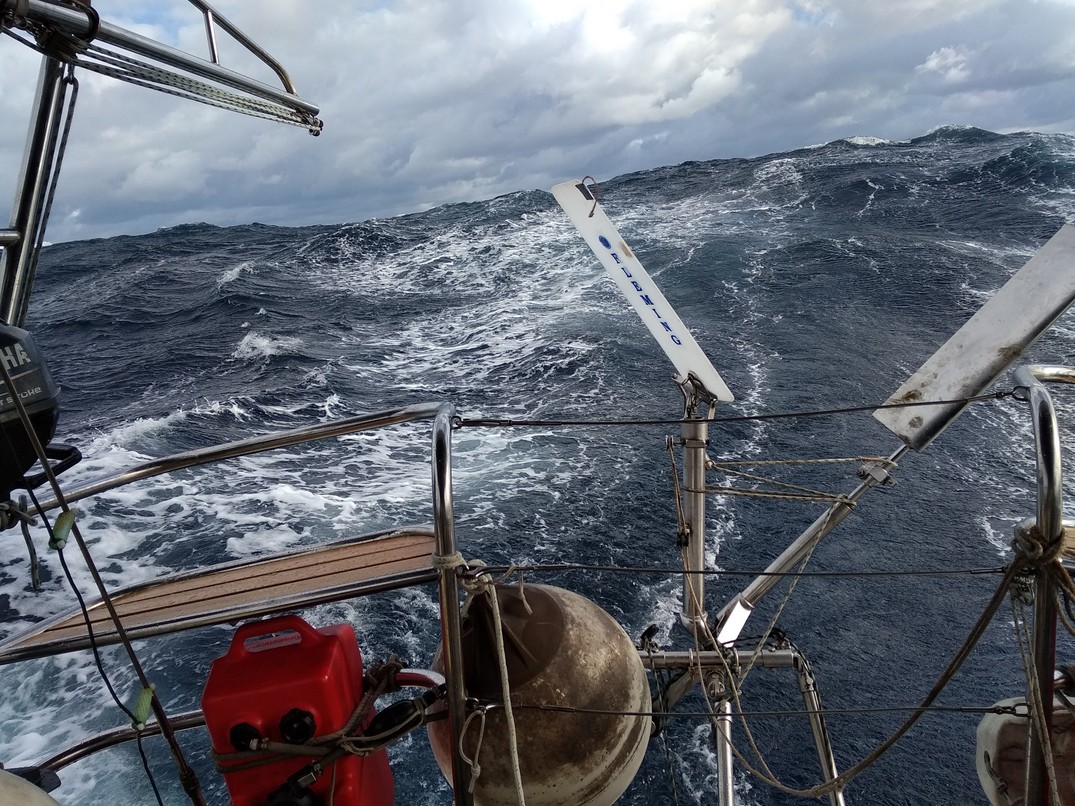
With the torch in my mouth, I climbed into the engine room to look for the source, and there it was running like Victoria Falls from the port lazarette base – cascades of salt water – right over the old autopilot. What? Why that much water? Back outside, I looked at the water flowing over the deck and lazarette, but that couldn’t cause that amount of water to enter the vessel, so what was it? As soon as I opened the lazarette hatch, I understood the situation. The compartment was almost full of water with containers floating on the surface. I removed a few, and there, right in front of me, as one of the larger waves broke and tumbled down
towards the stern of Malua, the white water came over the swim platform and washed halfway up the stern before draining away. Why into the locker? The locker contained the two gas bottles. A safety hole permits excess gas to drain out onto the swim platform on the stern.
The gas drain hole is more than 20cm round, so a wave that floods the swim platform can flow inwards to the locker. Now under normal circumstances, the odd wave over the stern causes no harm or flooding of the gas locker, but with the steep swell and the rolling waves from their tops down the face and into Malua, well, that was a different matter.
After repeated waves over the stern, the rate of in-flow was greater than the out-flow from the exit hole, and the locker started to fill. Its only exit was down a gap in the floor created when I removed the autopilot to fix it. I hadn’t had the opportunity to fibreglass the interior, and the seawater drained into the interior of Malua, setting off the bilge alarm.
I went down below to the emergency stores for a wooden plug and hammer and back to face the oncoming waves. I hung over the stern to put in the wooden plug. A good tap/strike with the
hammer, and it would stay in place till I reached land. After a few minutes, the bilge alarm stopped, and all stations returned to normal storm tactics.
At that point, I took a deep breath and went below, put the kettle on for some hot tea, and settled into my captain’s chair as I watched the wind go up and down to a high of 40 knots and an average of just a little over 30 knots. Malua, as always, handled the conditions well; the new autopilot had a few bad calls, but what can you expect, being so inexperienced?
It was now dark, but I could still see the white waves behind me as we raced forward down some of the steepest seas I have ever seen. Not
for a moment did I consider further reducing sail or changing course… we were in a groove.
The day dawned with no sleep but an uneventful night and many miles under the keel. I had noticed that the wind was dropping, but then again, it may have been that it was daylight, and that made the conditions look a bit better. After a few more hours of steadily declining seas and wind, we were back on track for a smooth passage to New Caledonia.
I have been in a few storms in my time, from a very bad one off Cape Point in Cape Town to the knockdown a few days out from Tonga and one on passage to New Zealand, but this was the most severe with the steepest waves, though not the strongest winds. Thankfully, it lasted just over 12 hours, which is quite bearable considering.
The balance of the trip was very easy, with the sun coming out and the wind dropping on some occasions, which required I start the engine. I was able to time my arrival for dawn to go through the pass and motor towards Noumea city and marina. I made the mistake of telling the marina I was not going to stay with them, so I was relegated to the back of the line for clearance and, in fact, had to be boarded by Bio- security at the public wharf in the SW – not convenient. I did stop for fuel at the end of the jetty and some bread, then off to the Orphelinat Bay anchorage to get the tender ready to do the
rounds to clear in. A simple process requiring a few km on my folding bike.
Restock and ready for Denny to fly in for a few weeks cruising these delightful islands.
COVID interrupted my cruising plans and Malua did not get the attention all yachts deserve during that period. However when all was shipshape and it got cold in the winter I sailed north to warmer weather. The trip home had some surprises in store.
← Back to Storms at Sea · Voyages · Next: The Final Sprint Home →